Why AI-Ready Sensor Data Matters for Real-World Monitoring
Updated: Jul 21
Author: Kimia Shahbazi, Digital Chemist Lead, Sentia Technologies Inc.
A sensor can give you a number. Turning that number into a decision you can act on — and trust — is a different problem entirely. It is also the problem that determines whether a monitoring system works in the field or simply produces dashboards nobody believes.

The gap between sensing and knowing
Putting sensors in the field has never been easier. They are inexpensive, wireless, and small enough to scatter across a greenhouse, a field, or an entire supply chain. But a curious thing happens once they are deployed: organizations discover that having more sensors does not automatically mean having more insight.
The reason is simple. A raw sensor reading is just a number captured at a single moment — “relative humidity is 68%.” On its own, that number cannot tell you very much. Is 68% normal for this crop at this time of day? Is it climbing or holding steady? Is the sensor even reporting accurately right now, or has it quietly drifted out of calibration? And most importantly: should anyone do anything about it?
Think of the difference between a thermometer and a diagnosis. The thermometer gives you a temperature. A doctor turns that temperature into a decision by adding context — your history, what is normal for you, how the number is trending, and the judgment to know when it actually matters. Real-world monitoring needs that same leap: from a number to a decision. AI-ready sensor data is what makes the leap possible.
What “AI-ready” actually means
It is tempting to think the path to insight is just collect the data, then point a model at it. In practice, that almost never works, because real-world sensor signals are messy. They carry electrical noise, suffer dropouts, drift slowly away from the truth, and pick up interference from the very environment they are trying to measure. Feed that directly into even a state-of-the-art model and you get confidently wrong answers. Garbage in, garbage out is not a cliché in sensing — it is the default outcome.

AI-ready data is raw data that has been cleaned, contextualized, and structured so that whatever intelligence layer sits on top of it can actually be trusted. Getting there is a pipeline, not a single step. The signal has to be cleaned of noise and gaps. Meaningful patterns — the features that genuinely correspond to something physical — have to be pulled out. Unusual behavior has to be flagged. Readings from many sensors have to be combined into one coherent view. The system has to anticipate where conditions are heading, not just report where they are. And finally, all of that has to turn into a clear recommendation a person or system can act on.
Each of those stages quietly depends on the one before it. A forecast built on uncleaned data is a guess dressed up as a prediction. This is why the unglamorous, upstream work — making the data trustworthy before any model touches it — is what separates monitoring systems that hold up in the field from demos that fall apart the moment conditions get real.
Where the intelligence lives: at the edge, in the cloud, or both
Once you accept that sensor data needs processing, the next question is where that processing should happen. Some of it can run directly on the device, at the “edge,” right next to the sensor. Some of it belongs in the cloud, where there is effectively unlimited memory and computing power. You can see both stages in the lifecycle above: the edge acts as the fast, local reflex, while the cloud does the heavier reasoning.
A useful analogy is reflexes versus reasoning. When you touch a hot stove, your hand pulls back before your brain consciously decides to move it — that is a reflex, handled locally and instantly, with no time wasted. Planning your week, by contrast, is deliberate reasoning that draws on memory and weighs options. Edge processing is the reflex; the cloud is the reasoning.
The mistake is treating this as an either/or. The strongest systems use both, with each doing what it is best suited for. For slow-moving environmental signals — temperature, humidity, soil moisture — the cloud is often the natural home, because decisions do not need to be made in milliseconds and there is real value in comparing against long histories and many locations. For battery-powered wireless nodes, on-device processing earns its place by deciding what is even worth transmitting, since sending raw data over a radio is one of the most power-hungry things a remote sensor can do. Edge and cloud are not competitors; they are complements.
One sensor is a data point; many sensors are a picture
A single sensor, no matter how good, is myopic. It sees one spot. But the environments worth monitoring — a greenhouse, a field, a growing room — vary across space and over time. The temperature near a vent is not the temperature in the far corner. Moisture at one end of a field is not moisture at the other.
This is where sensor fusion comes in: combining many sensors, and often several different types of sensors, into a single, coherent understanding of what is actually happening. The analogy here is one thermometer versus a weather map. A weather map is not just a lot of thermometers shown at once — its real value is in the relationships between the readings, which reveal fronts, gradients, and patterns that no single point could ever show.
Fusion does something else, too: it makes the whole system more robust. When one sensor drifts, fails, or drops offline, its neighbours keep the overall picture intact. Instead of a single point of failure, you have a system that degrades gracefully — which matters enormously when real decisions depend on it.
Trust is the foundation: calibration, drift, and validation
All of this rests on a single, easily overlooked truth: an insight is only as trustworthy as the data beneath it. And sensor data, especially from low-cost hardware, does not stay trustworthy on its own. Sensors drift. Heat, humidity, and age all slowly push readings away from the truth, often without any obvious sign that anything is wrong.
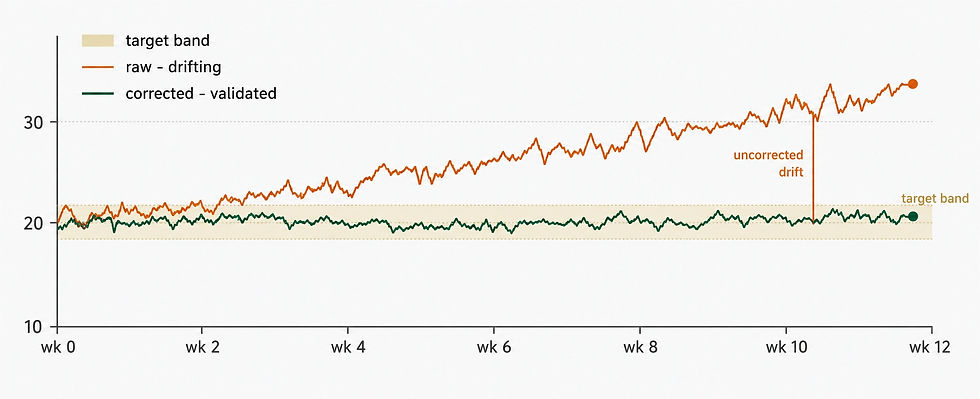
Keeping data trustworthy is an active, ongoing discipline with three parts. Calibration aligns a sensor to a known ground truth, so its readings mean what they claim to mean. Drift correction keeps that alignment intact as conditions and components change over time. And validation continuously checks that what the system reports still matches reality, catching problems before they propagate into decisions.
Skip this work, and you invite the single most dangerous failure mode in monitoring: a system that is confidently wrong. A monitoring system you cannot trust is arguably worse than no system at all, because people act on what it tells them. Trust is not a feature you bolt on at the end. It is the foundation everything else is built on.
From sensing to decisions
Strip it all back and the point is straightforward. AI-ready sensor data is the bridge between “we have sensors” and “we can make better decisions.” Everything in between — cleaning the signal, choosing where the intelligence runs, fusing many views into one, and keeping the data honest — exists to make that bridge strong enough to stand on.
For environmental and agricultural monitoring, where the stakes are crop health, resource efficiency, and sustainability, that bridge is the whole game. The hardware gets the numbers. Getting from those numbers to decisions a grower can trust is the harder, more valuable problem — and it is the one worth building for.
Comments